Sloes
Going foraging to make sloe gin

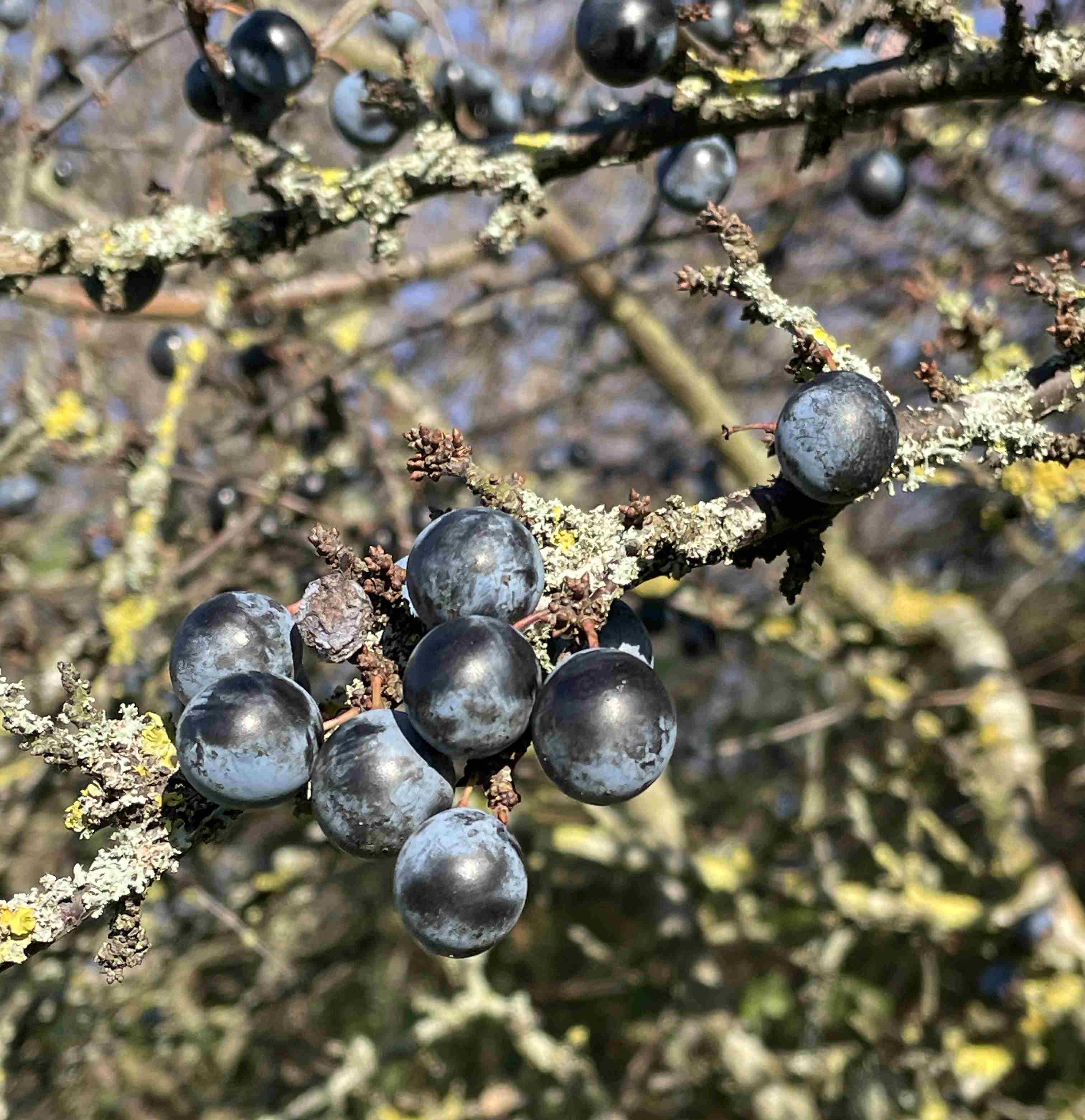
The blue black fruit contrasts beautifully with the gold and green lichen
When Autumn comes we monitor the sloe crop in the local hedgerows. They are a beautiful, tempting fruit looking like blueberry sized plums. Put one in your mouth and you’ll spit it out - it’s horribly tart, sour, astringent. The birds hold off eating them until late winter. We wait until there has been some frost before picking. These days that means a long wait, until well into November. Richard Mabey, in ‘Food for Free’, writes of picking them in October, giving you enough time to make the sloe gin for Christmas. But his book was published nearly fifty years ago, and frosts start later, and less often now. You need the frost to soften the skins, and I think it sweetens the fruit. An alternative is to pick them any time and put them in the freezer until you want to use them.
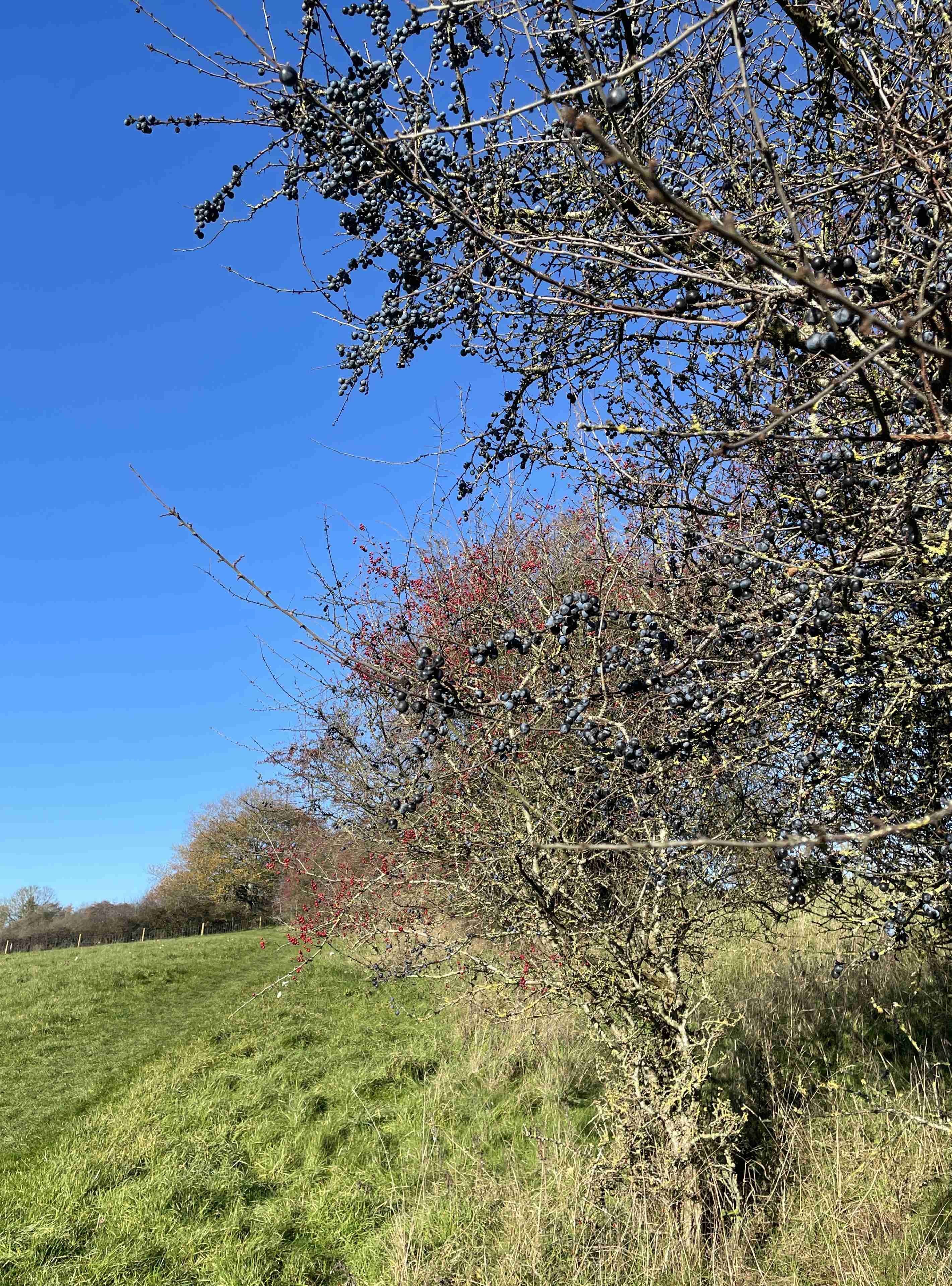
The abandoned hedge, with ‘sloes’ and hawthorn
Last weekend, after a cold week, we went to our nearest sloe-spot, in the hedges around the field at the top of the hill. There are some sizable bushes in the grown-out hedges. Like all the trees this year there is a good crop, the thin branches heavy with fruit. But as we started picking Andy said, ‘Are these sloes?’ For the last thirty years I’ve been walking this way and assumed they were sloes. At first glance they look like them. Closer examination suggests they’re not. The fruits are larger than normal sloes, more the size of a small grape than a blueberry. Also, sloe bushes are spiny, with thorns several centimetres long, making picking painful. But these bushes don’t have thorns. Something I’ve assumed turns out to be something else. We discussed what these could be. Perhaps Aylesbury prunes, a local variety of damson. Andy had bought some this autumn. Even cooked with sugar they had the same mouth puckering tartness of fresh sloes, and we threw them away. Those were more egg-shaped than these ‘sloes’. Bullaces or wild plums also grow in hedgerows, but these ‘not sloes’ don’t seem ‘plummy’ enough for either.
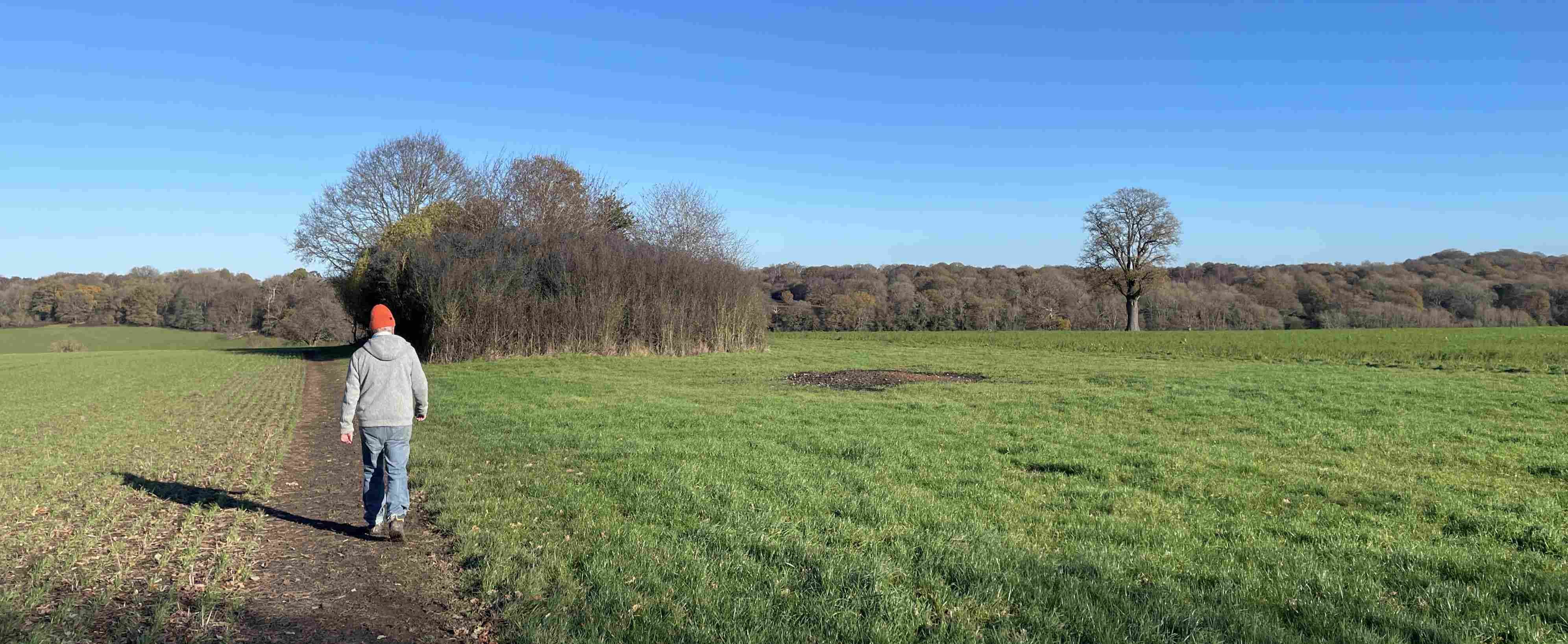
The thicket to the right of Andy is formed of ‘sloe’ suckers. The trees in the background are on Berkhamsted Common.
Moving along the hedges we realise that there are patches of this same fruit throughout the area. They have suckered like wild sloes, and form thickets where they have not been cut back. I guess they were deliberately planted by humans. We know when that probably was – this land was the Castle deer park, until it was ‘disparked’ in the seventeenth century, in Charles I’s time. Then the land was converted into farmland, and the hedges planted. A plan from the eighteenth century shows a dense mosaic of small hedged fields. Many of the hedges have been removed since to make more usable sized fields. The hedges where we were foraging are remnants, no longer boundaries, in what was until recently a sheep pasture. Considering the hedges more carefully I can see that the plants were chosen for their usefulness to the rural people, not just to make enclosures. On a preindustrial farm everything had to have multiple uses. There is a lot of hornbeam, an excellent firewood, as well as a good hedging plant on heavy soil; ash for tool handles; hazel for sticks as bean supports and to make hurdles. The hedges are distinguished by some fine standard oak trees, planted for timber for ships and barns. They planned ahead for what turned out to be a different future. Perhaps the thornless ‘sloes’ were planted for their fruit, as well as for hedging. The early 19th century writer William Cobbett says that sloes were seeped in brandy to make ‘port’, so perhaps there was a market for the fruit for that purpose.
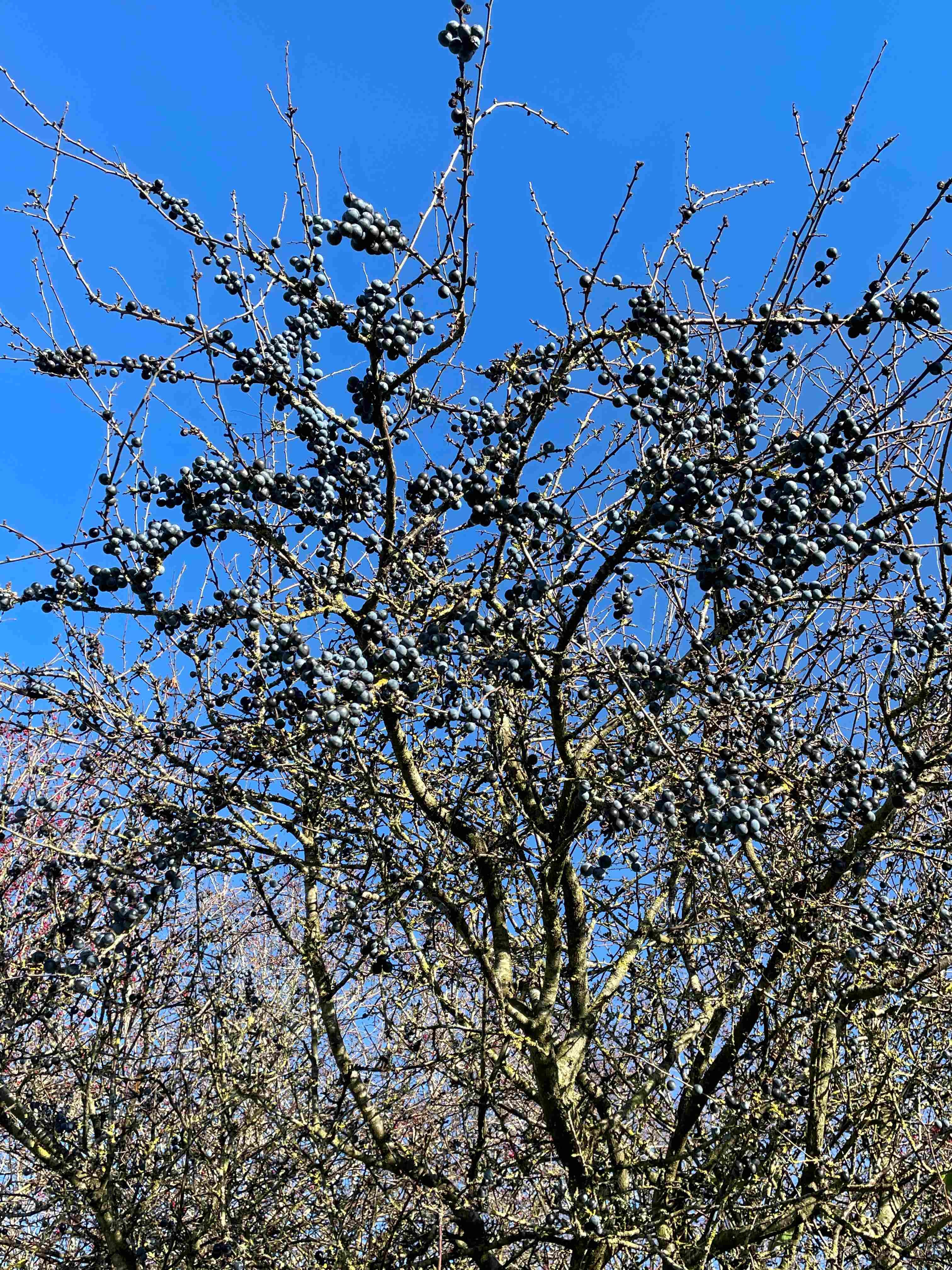
A tree heavy with fruit.
Sloes are the fruit of blackthorn, one of the commonest hedging plants, and when it runs wild it is the archetypal ‘scrub’ shrub. It cohabits with the other hedging and scrub thorn, hawthorn. The blackthorn blooms in March with clouds of dazzling white flowers, a precursor of spring. My father told me the time it flowers is called ’blackthorn winter’ as it often coincides with the last cold snap of the winter. It’s then that it is most visible, as the rest of the year it is a dull, understated plant. Its thorny entanglement makes it a popular plant for stock proof hedging, along with the hawthorn. It suckers enthusiastically, so any field left ungrazed or unploughed which has blackthorn in its hedges will quickly become an impenetrable thicket. I associate it with derelict farmland. There’s not much blackthorn on the Common, and what there is close to fields, or where there used to be arable fields. It does not seem to have quite the same taste for the wild as the hawthorn, which grows widely over the common.
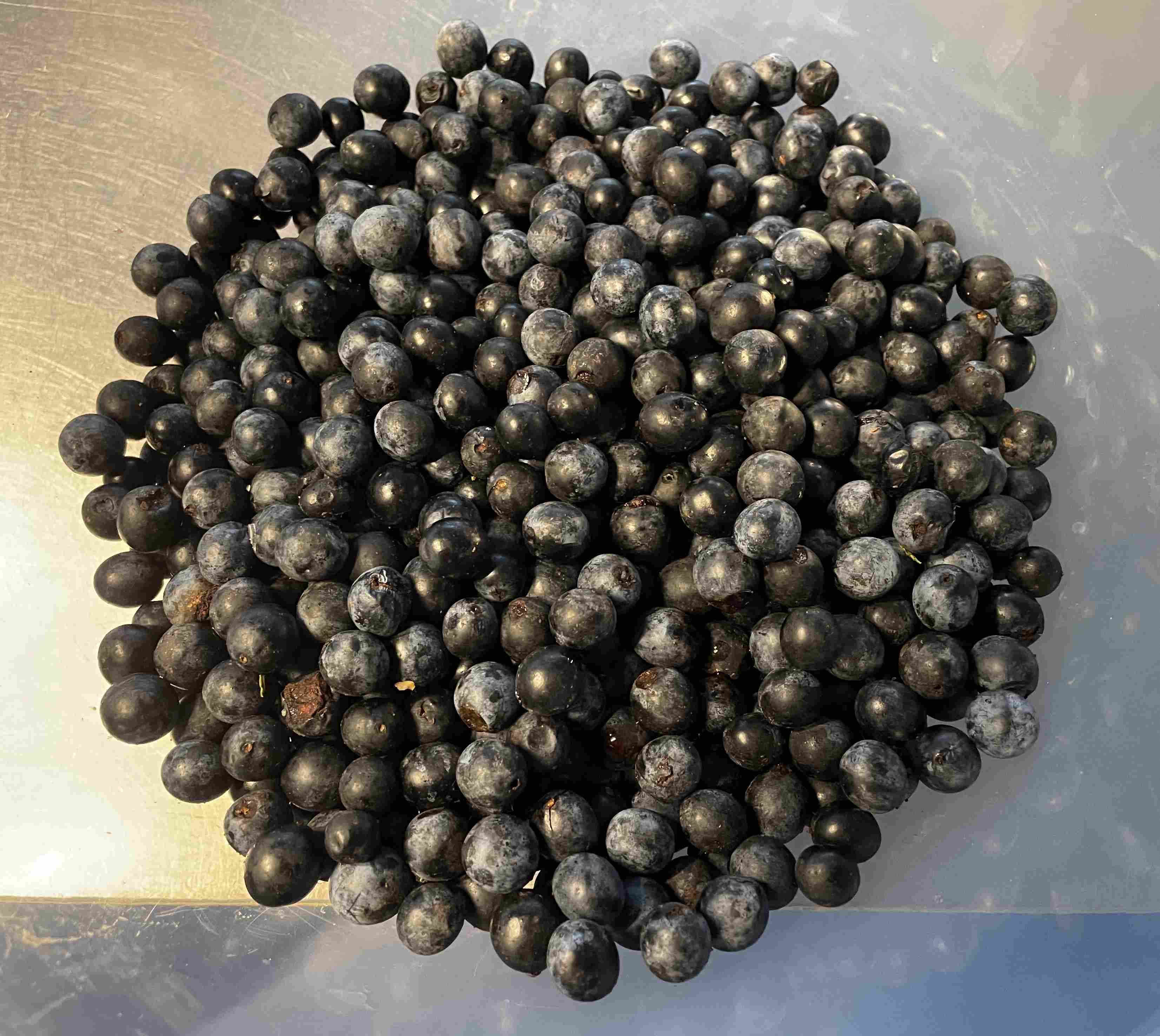
Our harvest
We pick a bag of the ‘sloes’, having established that yes, I had used them to make sloe gin before. This does not take long, and the bushes remain heavy with fruit as we leave. At home I consult a couple of books to remind me how to make the sloe gin. They’re not really recipes; all it is is flavouring gin. Richard Mabey, in ‘Food for Free’ simply says use equal weights of sloes and sugar (it is very sweet) and top up with gin. Hugh Fearnley-Whittingstall is more precise – 600g each of sloes and sugar, 500ml gin. They don’t mention that you need a wide necked bottle to get the sloes in. I fill two bottles: the quantities unevenly split between them. I use Gordon’s gin, a London gin. I think you need one with a traditional flavour. Then you leave it, turning the bottles each day. Gradually the sugar dissolves, the sloes sink down, and the liquid turns pink then ruby. I’ll leave it for a year. Recipes claim you can drink it after a month or two. I’ve tried that in the past and found it did not taste right, the flavours had not blended together enough, so this is for Christmas 2026.
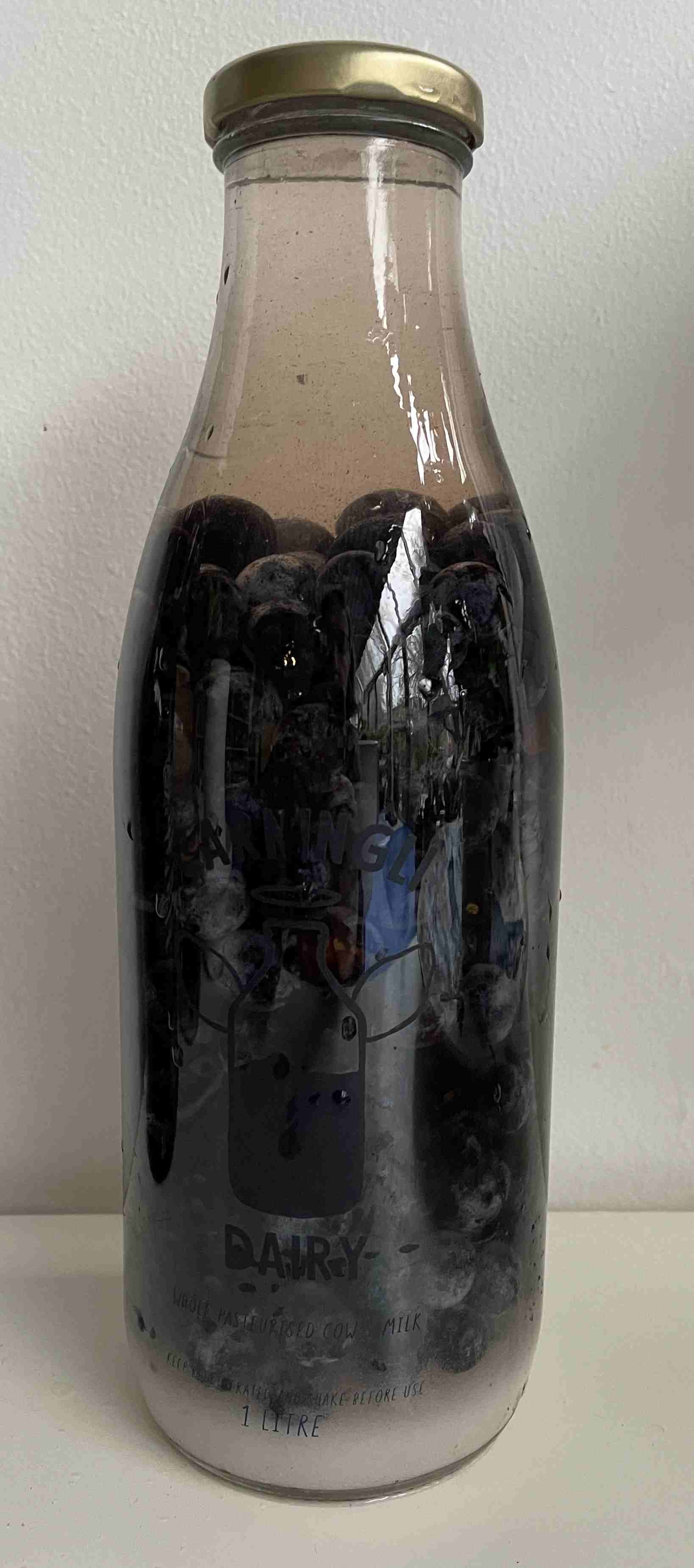
Now leave for a year
There's a wonderful foraging spot under the A41 up the hill from Thomas Coram school. There are at least two varieties of plums (maybe one is a damson? I made jam from them this year and it was so amazing I wrote a poem about it!), an apple tree, sloes, masses of blackberries and the ground is covered in mint!
That's good to know, Jenny - thank you! We'd always assumed they were sloes, and treated (drank!) them accordingly.